
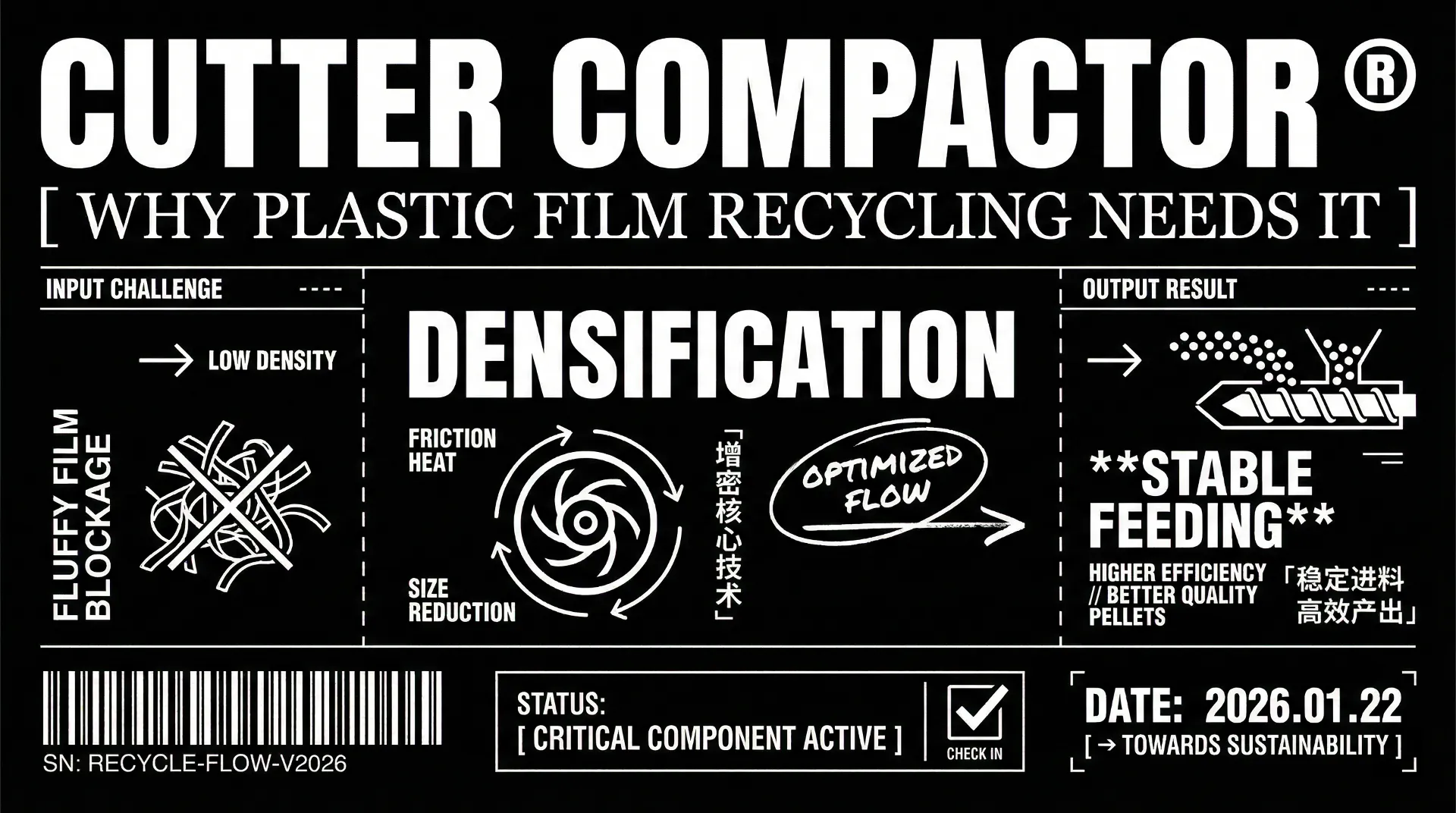
Recyclagemachines voor kunststoffolie worden geconfronteerd met een probleem waar verwerkers van harde kunststof nooit mee te maken krijgen: zachte folie wordt niet goed door standaard extruders gevoerd. Als u al eens geprobeerd hebt om LDPE-zakken, LLDPE-rekwikkels of landbouwfolie door een conventioneel systeem met vultrechters te laten lopen, hebt u waarschijnlijk te maken gehad met een onregelmatige uitvoer, productiestops en gefrustreerde operators.
De oplossing is niet een grotere trechter of een ander schroefontwerp. Recycling van zacht plastic vereist verdichting vóór extrusie. Daarom gebruiken professionele folierecyclingbedrijven geïntegreerde verdichter pelletiseermachine systemen die het voedingsprobleem bij de bron oplossen.
Waarom zachte film niet kan worden ingevoerd in standaard extruders
Standaard extruders zijn ontworpen voor harde kunststof vlokken, regranulaat en pellets-materialen met een bulkdichtheid tussen 400-600 kg/m³. Zachte kunststoffolie heeft een bulkdichtheid van slechts 30-50 kg/m³, waardoor drie kritieke voedingsproblemen ontstaan.[1]
Hopperoverbrugging en stroomonderbreking
Losse folie creëert bogen of bruggen over de trechteropening, waardoor de materiaalstroom wordt geblokkeerd. Wanneer de brug instort, wordt de schroef overspoeld door een stortvloed aan materiaal, gevolgd door verhongering wanneer de volgende brug wordt gevormd. Deze cyclus maakt consistent smelten onmogelijk.
Dit fenomeen doet zich voor omdat folie door zijn lage gewicht en hoge oppervlaktewrijving zijn eigen gewicht kan dragen over open ruimtes. Stijve vlokken, die dichter en korreliger zijn, stromen door de zwaartekracht zonder te overbruggen.[2]
Schroefverhongering door lage bulkdichtheid
Zelfs als de folie in de toevoeropening komt, sluit deze niet aan op de schroefvluchten zoals bij stijf materiaal het geval is. De schroefdraad draait door los materiaal zonder het vast te grijpen en genereert niet de compressie die nodig is om het materiaal naar voren te duwen en druk op te bouwen.
Hierdoor draait de extruder gedeeltelijk uitgehongerd. Operators zien een inconsistente stroomsterkte van de motor, fluctuerende smelttemperaturen en uitvoersnelheden die ver onder de nominale capaciteit van de machine liggen.
Luchtinsluiting en verwerkingsproblemen
De film wikkelt zich rond zichzelf, waardoor luchtbellen worden ingesloten die naar de smeltzone worden gevoerd. Deze luchtbellen veroorzaken schuim, porositeit in de pellets en oxidatieve degradatie door de verhitte lucht. Het vacuümontgassingssysteem, dat groot genoeg is voor normaal materiaal, kan het volume van de ingesloten lucht niet aan.
Hoe snijverdichtingssystemen de folietoevoer oplossen
Een snijder-kompactor pelletisatiemachine pakt deze problemen aan door een verdichtingsfase toe te voegen vóór de extruder. Het systeem heeft twee hoofdcomponenten: een cutter-compactor kamer en een enkelschroefs extruder.
Verdichtingsfase
De folie komt in een verwarmde kamer met roterende messen en een compressieschroef. De bladen snijden de folie in kleinere stukken terwijl wrijving en zachte warmte (80-120°C) het materiaal zachter maken. Roterende compressieschroeven dwingen de zacht geworden folie samen, waardoor lucht wordt verdreven en een dichte, samenhangende massa ontstaat met een bulkdichtheid die stijgt tot 300-400 kg/m³.
Dit verdichte materiaal gedraagt zich als stijve vlokken. Het vloeit consistent, past zich aan in de schroefvluchten en beweegt voorspelbaar door het systeem.
Gecontroleerde toevoer naar extruder
De verdichter voert verdicht materiaal rechtstreeks in de toevoeropening van de extruder, waardoor de materiaaltoevoer constant blijft, ongeacht wat er stroomopwaarts gebeurt. Dit elimineert de problemen met brugvorming en verhongering waar systemen met vultrechters last van hebben.
De extruder ontvangt een constante stroom voorverwarmd, luchtvrij materiaal met een consistente bulkdichtheid. De operator kan de output regelen door de snelheid van de compactor aan te passen, waardoor uur na uur een stabiele productie wordt bereikt.
Verbeterde ontgassing
Omdat de compactor de meeste ingesloten lucht voor de extrusie uitdrijft, werkt het vacuümontgassingssysteem binnen zijn ontwerpparameters. Dit produceert schonere pellets met minder defecten en maakt de verwerking mogelijk van geprinte films waarbij vluchtige stoffen uit inkt moeten worden verwijderd.
Materiaaltoepassingen voor compactorpelletiseermachines
Compactorsystemen blinken uit met materialen die conventionele extruders uitdagen:
- LDPE- en LLDPE-folie: Rekfolie, palletfolie, zakken voor producten, winkeltassen voor de detailhandel
- Landbouwfilm: Dekzeilen voor kassen, kuilfolie, mulchfolie (na wassen)
- Industrieel folieschroot: Randafwerking van folie-extrusie, afgekeurde productie, roluiteinden
- HDPE-folie: T-shirtzakken, verpakkingsfolie voor levensmiddelen
- PP geweven materialen: Raffiazakken, cementzakken, jumbozakken (FIBC's) na versnippering
Deze materialen hebben gemeenschappelijke kenmerken: lage bulkdichtheid (minder dan 100 kg/m³), hoge flexibiliteit en de neiging om zich te nestelen of te klitten. Ze hebben allemaal baat bij verdichting vóór extrusie.
Prestatievergelijking: Standaard vs. verdichtingssystemen
Bij de verwerking van 200 kg LDPE-rekfolie per uur heeft een standaard 100mm extruder met vultrechtervoeding moeite om de uitvoer op peil te houden. De operators melden veelvuldige brugvorming, uitvoerschommelingen van ±30% en veelvuldige stops om de hopper leeg te maken.
Dezelfde extruder in combinatie met een cutterverdichter haalt consistent de nominale capaciteit, met een outputvariatie van minder dan ±5%. De verdichter voegt 37-45 kW motorvermogen toe, maar elimineert de productieverliezen door inconsistente toevoer. De meeste bedrijven verdienen zich binnen 12-18 maanden terug dankzij de verbeterde opbrengst en de kortere stilstandtijd.
Het energieverbruik neemt met ongeveer 15% toe met een compactorsysteem, maar dit wordt gecompenseerd door een hogere verwerkingscapaciteit en een betere pelletkwaliteit waarvoor een hogere prijs moet worden betaald.[3]
Belangrijkste ontwerpkenmerken
Niet alle perssystemen leveren dezelfde prestaties. Controleer bij het beoordelen van apparatuur deze specificaties:
Volume perskamer: Moet 3-5 minuten verblijftijd bieden bij nominale capaciteit. Te kleine kamers kunnen materiaal niet goed verdichten; te grote kamers veroorzaken overmatige materiaaldegradatie.
Verwarmingsregeling: Onafhankelijke temperatuurzones voorkomen oververhitting en zorgen tegelijkertijd voor voldoende zachtheid. Zoek minimaal 2-3 regelbare zones.
Bladconfiguratie: Vervangbare snijbladen verlagen de onderhoudskosten. Het mesontwerp beïnvloedt het stroomverbruik en de verkleining van de materiaalgrootte.
Voerinterface: De directe koppeling tussen de verdichter en de extruder zorgt voor een consistente materiaaloverdracht. Vermijd systemen waarbij materiaal tussen de componenten valt.
Is een perscontainersysteem geschikt voor uw bedrijf?
Kies voor een compactorpelletiseermachine als je voornamelijk zachte folie en zakken verwerkt. De investering is zinvol als folie meer dan 60% van je grondstof uitmaakt of als je aanhoudende problemen hebt met je huidige systeem.
Bedrijven die gemengd materiaal verwerken - een deel harde materialen, een deel folie - profiteren van de veelzijdigheid van een perssysteem. De verdichter verwerkt folie effectief terwijl hij hard materiaal normaal verwerkt, wat u flexibiliteit geeft als de samenstelling van de grondstof verandert.
Installaties die uitsluitend harde kunststof verwerken (flesschilfers, verpakkingsresten, leidingschroot) hebben zelden verdichting nodig. Een standaardextruder met het juiste trechterontwerp is voordeliger voor deze toepassingen.
Filmrecycling winstgevend maken
Filmrecycling heeft moeite om economisch te concurreren omdat de transport- en verwerkingskosten vaak hoger zijn dan de pelletwaarde. Compactorsystemen verbeteren de rendabiliteit door de verwerkingscapaciteit te verhogen, de arbeidskosten voor het oplossen van voedingsproblemen te verlagen en pellets van hogere kwaliteit te produceren die tegen een hogere prijs worden verkocht.
De Rumtoo ML-serie demonstreert deze benadering en verwerkt 150-1200 kg/u afhankelijk van de modelgrootte, met geïntegreerde verdichting, ontgassing en filtratie in één enkel systeem. Het ontwerp richt zich op de volledige uitdaging van het recyclen van zacht plastic, niet alleen extrusie.
Succesvolle folierecycling vereist apparatuur die is afgestemd op de materiaaleigenschappen. Als uw grondstof zachte folie met een lage dichtheid is, verandert een compactorpelletiseermachine een moeilijk proces in een betrouwbare, winstgevende bewerking.