
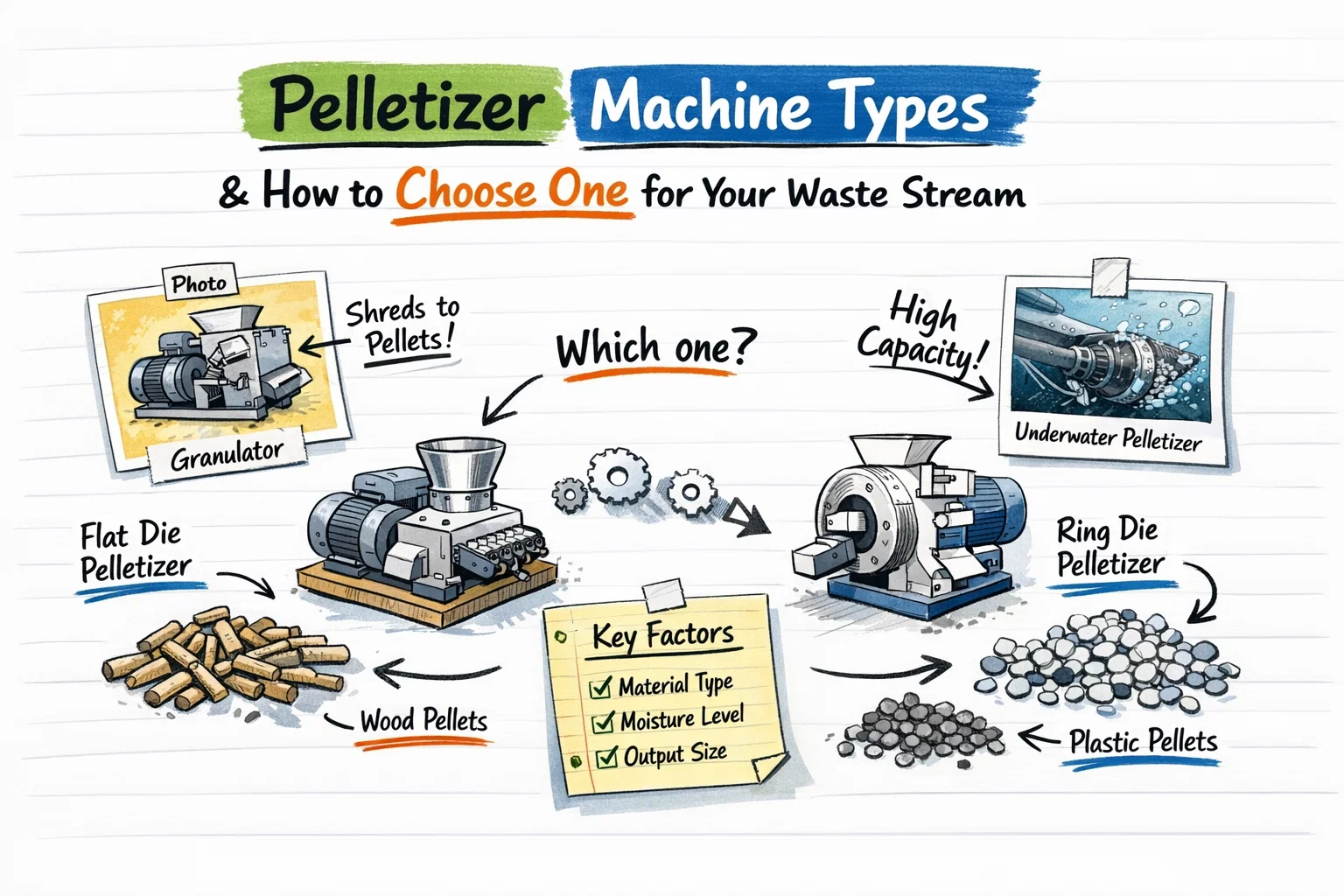
Tipos de máquinas peletizadoras: O guia completo para escolher a mais adequada
Investir nos tipos errados de máquinas peletizadoras é o erro mais comum - e mais caro - que vemos na indústria de reciclagem de plásticos. Pode ter um armazém cheio de películas de PEBD valiosas, mas se as alimentar com uma extrusora de parafuso único concebida para tubos rígidos, vai ter de enfrentar um aumento constante, um baixo rendimento e pellets degradados.
Na Rumtoo, acreditamos que o seu fluxo de resíduos dita a sua máquina, e não o contrário. Quer se trate de uma película pós-industrial, de um material reciclado de PEAD rígido ou de flocos de PET, a rentabilidade da sua operação depende da correspondência entre a “forma” dos seus resíduos e a física da extrusora.
Este guia elimina o ruído técnico para o ajudar a compreender exatamente que tecnologia de peletização se adequa aos seus objectivos específicos de reciclagem.
1. A alimentação: Lidar com o fator “forma”
Antes mesmo de o plástico atingir o parafuso, tem de entrar na máquina. É aqui que ocorrem 80% dos problemas de processamento. A densidade do seu material - quer se trate de película fofa ou de aparas pesadas - determina a tecnologia de alimentação de que necessita.
Para plásticos leves e macios (películas, sacos, ráfia)
Se reciclar películas PE/PP, sacos de tecido ou materiais espumados, depara-se com um problema de densidade. Estes materiais são demasiado leves para caírem naturalmente num parafuso.
A solução: Linhas integradas de cortadores e compactadores
Também conhecida como um sistema “3 em 1” (como a nossa série ReadyMac), esta máquina combina um compactador de corte diretamente com o parafuso de extrusão.
- Como funciona: Uma grande panela na base da máquina corta, seca e aquece por fricção o plástico até este se densificar. A força centrífuga empurra então este material quente e denso diretamente para o parafuso da extrusora.
- Porque é que precisa dele: Elimina a necessidade de um aglomerador separado e assegura que o parafuso está sempre cheio, evitando “surtos” (produção desigual).
Para plásticos pesados e rígidos (Regrind, Flakes)
Se processar garrafas esmagadas, tubos, caixas ou resíduos electrónicos de ABS, o seu material já é suficientemente denso para fluir por gravidade.
A solução: Sistemas de tremonha ou alimentador de força
Uma tremonha normal funciona muitas vezes para o fluxo livre de material triturado. No entanto, se estiver a misturar materiais leves e pesados, um alimentador de força lateral ajuda a empurrar o material para o parafuso para manter um elevado rendimento.
2. O motor: Extrusoras de parafuso simples vs. de parafuso duplo
Quando o plástico está no interior, tem de ser derretido e pressurizado. O debate entre parafusos simples e duplos é muitas vezes mal compreendido.
Extrusora de parafuso único (O cavalo de batalha)
A grande maioria dos trabalhos de reciclagem - especialmente para PE e PP - utiliza extrusoras de parafuso único. Estas são excelentes para gerar a alta pressão necessária para empurrar o plástico sujo através de ecrãs de filtragem fina. São económicas, fáceis de manter e eficientes em termos energéticos para materiais que não requerem misturas complexas.
Extrusora de parafuso duplo (O misturador)
Os parafusos duplos utilizam dois parafusos entrelaçados. Geralmente é necessário para:
- Composição: Adição de cargas (como o carbonato de cálcio) ou de fibras de reforço.
- Reciclagem de PET: O PET requer um tratamento cuidadoso da humidade e da viscosidade (IV), que os parafusos duplos gerem melhor através de capacidades superiores de desgaseificação por vácuo.
- Materiais sensíveis: Se necessitar de um controlo preciso da temperatura para evitar a degradação.
Dica Pro: Para a maioria das instalações de lavagem e reciclagem pós-consumo (PE/PP), um único parafuso com uma geometria especializada (rácio L/D de 30:1 ou superior) proporciona o melhor equilíbrio entre ROI e durabilidade.
3. O corte: Anel de água vs. Peletização de cordões
A forma como se corta o plástico determina a forma e a qualidade do produto final. Esta escolha depende em grande medida da “força de fusão” do polímero.”
Anel de água (face da matriz) Peletização
Esta é a norma do sector para a reciclagem de PE e PP.
- Processo: As lâminas cortam o plástico imediatamente à saída da cabeça da matriz e os granulados são imediatamente atirados para um anel de água de arrefecimento.
- Melhor para: Polietileno (PE) e Polipropileno (PP). Estes materiais podem colar-se uns aos outros se não forem arrefecidos rapidamente.
- Vantagem: É altamente automatizada. Mesmo que uma lâmina fique cega, a máquina continua a funcionar. É compacta e reduz os custos de mão de obra.
Pelotização de Fio
Este é o método tradicional do “esparguete”. Os fios de plástico são puxados através de um banho de água e depois cortados por um granulador.
- Melhor para: Plásticos de engenharia (ABS, PC), PET e materiais de elevado MFI (plásticos muito fluidos) que podem manchar num cortador de face de matriz.
- Vantagem: Produz pellets muito cilíndricos, de alta qualidade e com aspeto de material virgem.
- Desvantagem: Os fios podem partir-se, exigindo que um operador os volte a enfiar manualmente. Requer mais espaço no chão para o banho de arrefecimento.
4. A matriz de decisão: Correspondência entre material e máquina
Para simplificar a sua decisão de compra, mapeámos os fluxos de resíduos comuns para a configuração ideal da máquina que se encontra na nossa página do produto.
| Fluxo de resíduos | Alimentação recomendada | Tipo de parafuso | Método de peletização
| - | - | - | - |
| Películas PE/PP (Lavado) | Cortador-compactador | Parafuso simples | Anel de água
| HDPE/PP rígido (Garrafas, tubos) | Funil / alimentador de força | Parafuso simples | Cordão ou anel de água |
| Flocos de PET (Garrafas) | Alimentador de Força + Cristalizador | Parafuso Duplo | Cordão |
| PVC (Macio ou Rígido) | Funil | Cónico Duplo / Simples | Face da matriz (Arrefecido) |
| Composição (Adicionando enchimentos) | Alimentador lateral | Parafuso duplo | Strand |
5. Factores críticos para além da folha de especificações
Quando comparar fabricantes, não se limite ao tamanho do motor. A eficiência de uma linha de reciclagem é frequentemente determinada por dois sistemas “ocultos”: Filtragem e Desgaseificação.
Filtragem (Trocadores de tela)
Os resíduos pós-consumo estão sujos. Se utilizar um sistema manual de troca de ecrãs, o operador terá de parar a máquina de 30 em 30 minutos para trocar os ecrãs, o que prejudica a sua eficiência.
Procurar comutadores de ecrã contínuos de pistão duplo ou filtros laser. Estes permitem que a máquina continue a funcionar enquanto o ecrã se limpa a si próprio ou enquanto um pistão está a ser substituído. Este funcionamento ininterrupto é vital para a rentabilidade.
Desgaseificação (ventilação)
A humidade é o inimigo. A tinta e a água transformam-se em gás no interior da extrusora, criando pellets porosos e “espumosos” que os compradores rejeitam.
Certifique-se de que a sua máquina possui zonas de desgaseificação a vácuo de elevada eficiência. Para películas muito impressas, uma sistema de ventilação dupla é frequentemente necessário para remover o elevado volume de voláteis libertados durante a fusão.
Resumo
Escolher a peletizadora certa não é encontrar a máquina mais barata; é encontrar a máquina que pode lidar com os piores dias do seu material (contaminação, humidade) enquanto fornece uma produção consistente.
Se estiver a processar película, o Cortador Compactador é o seu melhor amigo. Se estiver a manusear material de trituração rígido, um robusto Parafuso simples com um bom permutador de ecrã irá servir-lhe durante décadas.
Para obter mais informações sobre as especificações específicas das máquinas e para ver estes sistemas em ação, visite Rumtoo Máquinas de reciclagem. Configuramos as linhas com base no seu material de amostra específico para garantir zero surpresas aquando da instalação.