
2026 Buyer-Centric Guide
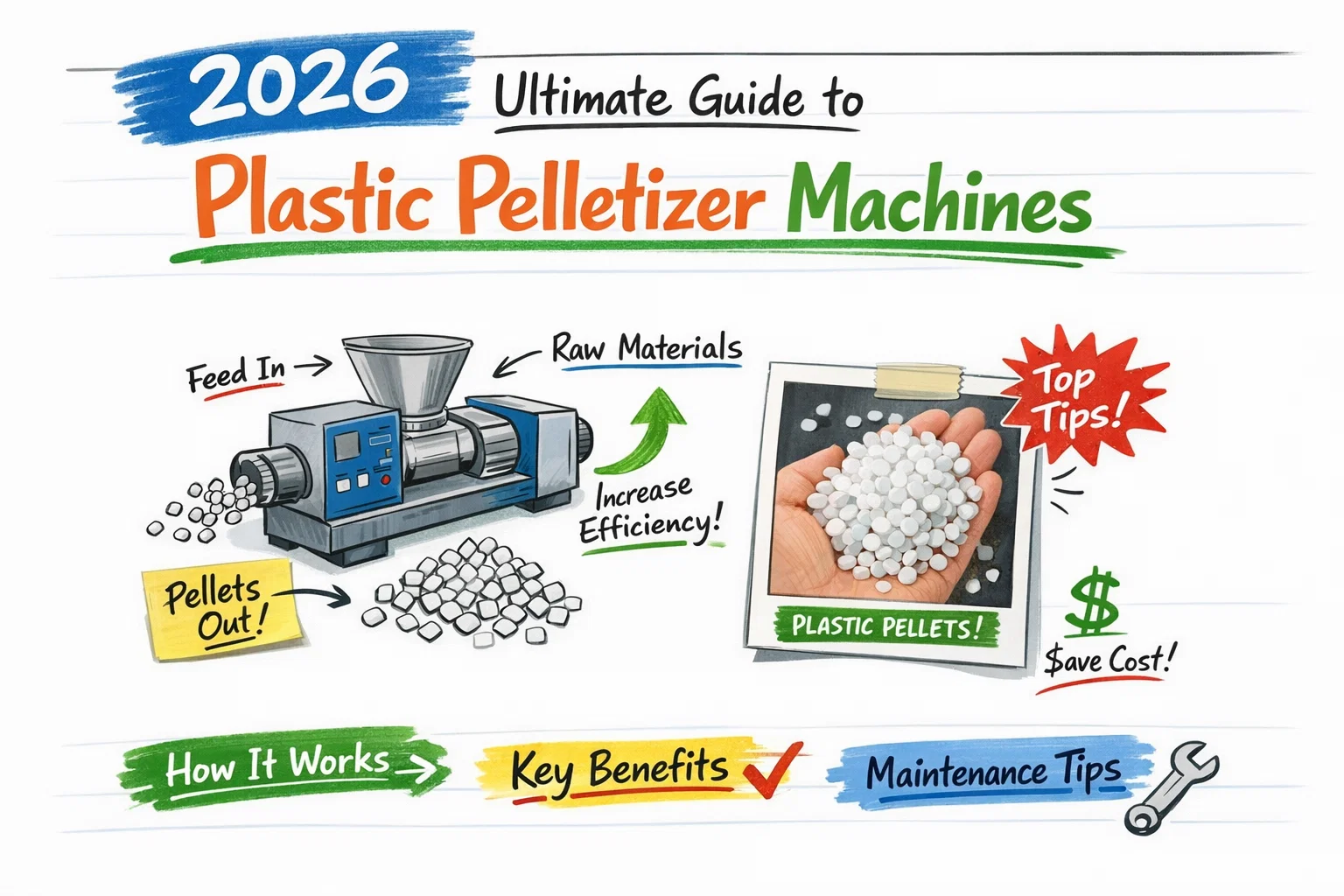
2026 Ultimate Guide to Plastic Pelletizer Machines
If you are evaluating a pelletizer machine for plastic recycling or reprocessing, this guide is designed to help you make a confident, engineering-aligned decision—without getting lost in brand noise or oversimplified “one-size-fits-all” advice.
What you will get from this guide
- A clear definition of what a plastic pelletizer is (and what it is not).
- A 2026 classification of pelletizing systems by cutting + cooling method and by process stage.
- A practical selection framework that ties material, contamination, capacity, and pellet quality to the right solution.
- Reality-check guidance on capacity, total cost of ownership, and ROI drivers.
- Common buying mistakes—and how to avoid expensive rework.
Quick links on your site
Use these for deeper reading while you evaluate options.
Products Overview What is a Pelletizer? Pelletizer Types Cost (Reference)
Pro tip: Your best ROI usually comes from matching the pelletizer to the real waste stream (moisture, inks, fines, fillers), not the “ideal” material described in a catalog.
On this page
- What is a plastic pelletizer machine?
- Why pelletizers matter in modern recycling
- Types of pelletizer machines (2026 classification)
- Pelletizing workflow (decision-level)
- How to choose the right pelletizer (buyer framework)
- Capacity, cost & ROI (what changes in 2026)
- Common buying mistakes
- Pelletizing trends in 2026
- FAQ
1) What Is a Plastic Pelletizer Machine?
A plastic pelletizer machine converts plastic (virgin polymer or recycled feedstock) into consistent, easy-to-handle pellets. In recycling applications, pelletizing typically sits after size reduction and washing/drying, and it turns irregular flakes or regrind into standardized pellets suitable for downstream manufacturing.
Pelletizer vs. Granulator vs. Extruder—clear roles
Granulator/Crusher: reduces size (flakes/regrind).
Extruder: melts, homogenizes, vents, filters, and pressurizes the melt stream.
Pelletizer (cutting system): cuts the polymer into pellets and works with a cooling method to solidify and convey pellets.
If you want a deeper technical primer, see: What is a plastic pelletizer and how does it work?
2) Why Pelletizer Machines Matter in Modern Plastic Recycling
Buyers do not invest in pelletizing for “nice-to-have” reasons. They invest because pelletizing can change what you can sell, to whom, and at what margin. Compared with flakes or regrind, pellets generally deliver stronger performance in:
- Consistency: stable bulk density and flow improves feeding on injection molding and extrusion lines.
- Quality control: filtration + degassing + controlled cutting can reduce gels, black specks, and moisture-driven defects.
- Logistics: pellets are easier to store, meter, and ship; they reduce bridging issues common with fluffy flakes/films.
- Commercial positioning: more buyers can qualify pellets than unpelletized output.
Not sure if pelletizing is worth it for your feedstock? Start from material photos, contamination level, and target pellet application. That determines the right process—and the right investment.
Explore pelletizing systems Selection by plastic type
3) Types of Pelletizer Machines (2026 Classification)
In 2026, the most useful way to classify pelletizing systems for buyers is by (A) cutting location and (B) cooling / conveying method, plus a second layer based on whether you need single-stage or two-stage processing.
| Type | Best fit | Strengths | Trade-offs to plan for |
| — | — | — | — |
| Strand pelletizer | Stable melts, lower-to-mid throughput, many general-purpose polymers | Simple concept, accessible maintenance, flexible operation | More floor space, strand handling sensitivity, pellet shape less spherical |
| Water-ring (die-face) | High-throughput non-hygroscopic materials; many recycling lines (PE/PP) | Fast cooling, compact footprint, good pellet uniformity | Water management + drying required; blade condition directly impacts pellet quality |
| Underwater pelletizer | High consistency pellets, automation, rPET and quality-sensitive applications | Excellent pellet uniformity, stable production, scalable for large plants | Higher system complexity; requires disciplined water/filtration management |
| Air / wind-cooled (die-face) | When water handling is constrained; selected materials and throughput ranges | Simplifies water loop requirements | Cooling limits and pellet deformation risk depend strongly on polymer and output |
For deeper comparisons on your site: Water ring pelletizers, Wind-cooled vs water ring, Strand vs underwater (rPET).
Single-stage vs. two-stage pelletizing (the decision you cannot ignore)
Many “bad pellet” complaints are not caused by the cutter—they’re caused by picking the wrong process stage architecture. As a buyer, your key question is whether your feedstock needs extra stabilization before final filtration and cutting.
- Single-stage: fits cleaner streams and stable melt behavior; simpler line and lower initial investment.
- Two-stage: fits higher contamination, variable thickness films, printed waste, and streams that benefit from extra degassing / homogenization.
4) Pelletizing Workflow (Decision-Level, Not a Textbook)
A practical pelletizing workflow is best understood as a sequence of “risk controls.” Each stage either removes a risk (moisture, volatiles, solids) or creates stability (uniform melt, stable pressure) that downstream cutting depends on.
Upstream: feed preparation
- Size reduction: consistent feed size improves melting stability.
- Washing & dewatering: moisture and dirt drive defects and screen changes.
- Film handling: for PE/PP films, dewatering and densifying steps are often decisive.
Related reading: How to recycle PE/PP plastic film
Core: melt quality stabilization
- Melting & homogenization: stable pressure = stable pellet shape.
- Degassing/venting: reduces odor and volatile-driven bubbles.
- Filtration: protects the die and cutter; improves pellet cleanliness.
If cooling method selection is your bottleneck, see: Cooling technology buyer’s guide
Buyer takeaway: If your supplier talks only about “pelletizer machine” but not about moisture control, filtration strategy, or melt stability, you are likely under-scoping the solution.
5) How to Choose the Right Pelletizer Machine (Buyer Framework)
To choose correctly, align four things: material, contamination & moisture, throughput, and target pellet use. Below is a concise framework procurement teams can use in RFQs and technical evaluations.
A. Start with the material reality (not the label)
- PE/PP films: typically benefit from disciplined drying/dewatering and stable feeding to avoid surging.
- Rigid plastics: often support stable melting; selection depends on output targets and filtration needs.
- rPET flakes: tends to be more quality-sensitive; pellet uniformity and moisture management are critical.
- Composite / multilayer: often requires stronger filtration strategy and sometimes twin-screw advantages.
Deep dive: Pelletizer for multi-layer & composite films
B. Define the “must-hit” pellet requirement
The right pelletizing system depends on what the pellets must do downstream. Common targets include: consistent pellet size, low moisture, low gels/black specks, minimal odor, and stable MFI behavior. Your pellet use case should be explicitly stated as: injection molding, sheet/extrusion, fiber, or general compounding.
C. Choose the cutting + cooling method that matches your throughput and quality
Rule of thumb: the higher your throughput and the tighter your quality window, the more you should prioritize controlled die-face cutting systems (water-ring/underwater) and disciplined water/drying management.
D. Validate capacity with “real-output questions”
- What is the rated throughput range—and under what feed conditions?
- How is pressure stabilized (especially for films and variable thickness feed)?
- What is the planned screen change interval, and what drives it?
- What pellet moisture target is realistic for the chosen cooling method?
6) Pelletizer Capacity, Cost & ROI (What Changes in 2026)
In 2026, buyers are increasingly judged on total cost of ownership rather than just purchase price. The right way to evaluate ROI is to model operational stability and yield—not only nameplate kg/h.
| ROI driver | Why it matters | What to ask suppliers |
| — | — | — |
| Yield & contamination control | Bad filtration / unstable melting increases waste, gels, and customer rejections. | What is the filtration strategy for my feedstock? What is the screen change plan? |
| Energy per kg | Energy cost volatility makes kWh/kg a long-term profitability lever. | Provide typical kWh/kg at my target throughput and expected moisture/contamination level. |
| Uptime & maintenance rhythm | Downtime in pelletizing often bottlenecks the entire line. | What are wear parts? Blade change intervals? Water loop maintenance? Spare parts list? |
| Pellet qualification success | Passing downstream specs can unlock better buyers and better pricing. | What pellet specs have you achieved on similar materials? Any reference configurations? |
Cost reference (for context): How much does a plastic pelletizing machine cost? and Price comparison: water ring vs strand. (Use these as baselines; actual configuration drives TCO.)
7) Common Mistakes When Buying a Pelletizer Machine
Most “pelletizer failures” are procurement and specification failures. If you avoid the mistakes below, you dramatically reduce project risk.
Mistake #1: Selecting by headline kg/h only
Nameplate capacity often assumes stable feed, controlled moisture, and ideal melt behavior. Real-world waste streams rarely behave that nicely.
Fix: validate capacity at your real contamination and moisture conditions.
Mistake #2: Under-scoping drying / dewatering
Moisture drives bubbles, splay, inconsistent pellet cut, and downstream processing defects. This risk is especially common with films and post-consumer streams.
Fix: treat moisture control as a core design constraint, not an accessory.
Mistake #3: Ignoring filtration strategy
Filtration is what protects the die and cutter and determines pellet cleanliness. Underestimating contamination leads to frequent screen changes and unstable pressure.
Fix: specify filtration stages and maintenance plan in the RFQ.
Mistake #4: Choosing cooling method without water/drying discipline
Water-based pelletizing can be excellent—but only if your plant plans for water quality, conveyance, drying, and routine checks.
Fix: evaluate the entire loop, not only the cutter head.
For quality-critical operations, see: Underwater pelletizing moisture control.
8) Pelletizing Trends in 2026 (What Buyers Should Watch)
The 2026 market rewards pellet producers who can deliver consistent quality with predictable operating costs. Three trends are shaping equipment selection and project economics:
- TCO-first procurement: energy per kg, uptime, and maintenance cadence increasingly dominate purchase decisions.
- Process stabilization for post-consumer streams: better degassing/filtration strategies to manage inks, labels, fines, and odor.
- Quality-driven pellet markets: tighter buyer requirements push plants toward more controlled cutting/cooling and better melt conditioning.
Practical guidance: If your business plan depends on premium pellet buyers, design the line for quality from day one: stable feeding, disciplined drying, robust filtration, and a pelletizing method that matches your throughput and material behavior.
9) FAQ (People Also Ask)
What is the difference between a pelletizer machine and an extruder?
In most pelletizing lines, the extruder melts, homogenizes, vents, and filters the plastic, while the pelletizer is the cutting system (plus cooling/conveying) that converts the melt into solid pellets. Buyers should evaluate them as one integrated system.
Which pelletizing method is best for PE/PP film recycling?
It depends on contamination, moisture stability, and required throughput. Many PE/PP film lines perform well with die-face systems when upstream dewatering and feeding are stable. If films are heavily printed or variable, two-stage stabilization and stronger filtration strategy may be needed. See related reading: PE/PP film recycling guide.
Can you pelletize dirty plastic?
“Dirty” plastic can often be pelletized, but it shifts the engineering focus to washing, drying, venting, and filtration. The right answer is not yes/no—it’s whether your line is designed to control contamination to meet the pellet specification your buyers require.
How do I estimate the right pelletizer capacity for my plant?
Start with your target output and work backward: upstream throughput, realistic uptime, screen change rhythm, and expected yield loss. Then validate with material-specific constraints (moisture, thickness variation, fines). Nameplate kg/h alone is not sufficient for investment decisions.
Where should I start if I want to compare pelletizer solutions quickly?
Use a structured evaluation: (1) material + contamination reality, (2) pellet quality requirement, (3) throughput range, (4) filtration & moisture control plan, (5) maintenance cadence and spare parts. Then review solution categories and short-list based on cutting/cooling type. Browse: Products overview.
Want a configuration recommendation based on your actual material? Share material photos, contamination notes, target capacity (kg/h), and your intended pellet application. We will map your requirements to an appropriate system architecture.
See equipment options Learn the basics
Suggested internal links for your cluster next: Water Ring vs Underwater, Single-stage vs Two-stage, Pelletizer Capacity & Cost (2026), and Material-Specific Guides (PE/PP film, rPET flakes, rigid plastics, composites).