How Centrifugal Dryers Enhance Plastic Recycling Efficiency
From the perspective of plant managers, production engineers, and procurement teams evaluating ways to boost throughput, reduce energy, and improve pellet/extrudate quality.
Rumtoo Machine works with recycling plants across the USA and Europe to design practical, high-return drying solutions. This guide explains what centrifugal dryers do, where they fit in your line, and how to choose the right model for your material mix and capacity targets—so you can justify the purchase with clear KPIs and a realistic ROI.
Executive summary (what you get by adding a centrifugal dryer)
Lower moisture at discharge for flakes, regrind, and film—stabilizing silo storage, preventing agglomeration, and protecting downstream extrusion/pelletizing.
Higher line throughput because mechanical dewatering is fast and continuous.
Lower specific energy vs. thermal-only drying; you spend less kWh removing the same kilogram of water.
Cleaner output: the high-g action sheds fines, labels, and residual wash liquor.
Better product quality in extrusion and pelletizing: fewer steam pops, smoother melt, steadier IV/MFI results.
(Illustrative visuals below are for orientation and engineering discussion; real performance depends on feed, wash chemistry, and screen/rotor configuration.)
What is a centrifugal dryer—and how is Rumtoo Machine’s design different?
A centrifugal dryer spins washed plastic at high speed inside a perforated drum. Centrifugal force slings water out through the screen while airflow carries away evaporated moisture and fines. Compared with hot-air tunnels, the work is mostly mechanical, so you remove more water per unit of energy.
Key design elements you should evaluate:
Rotor & knives/paddles: influence residence time, agitation, and fines removal. Rumtoo Machine tunes paddle geometry for rigid flakes vs. film.
Screens/perforations: hole size and open area govern drainage and particle retention; quick-release screen cages speed changeovers.
Materials of construction: contact parts in SS304 as standard; SS316 for caustic or high-chloride wash chemistry (common in EU bottle-to-bottle lines).
Drive & controls: VFD speed control, soft-start, motor protection, and interlocks. EU delivery includes full CE conformity documentation; US builds can be supplied with NEMA/UL-ready components on request.
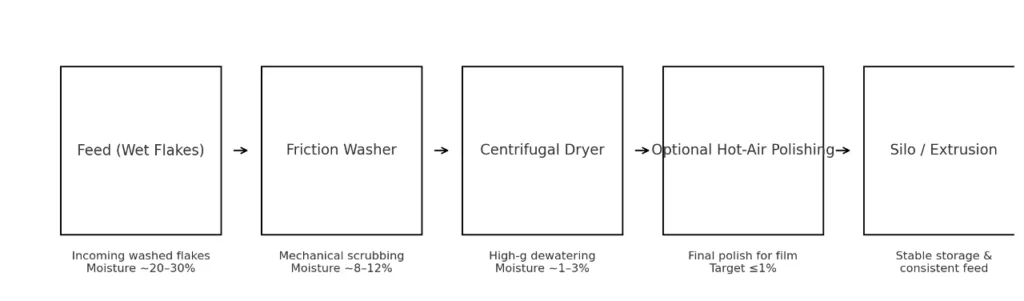
A typical PET/HDPE line washes at high temperatures with caustic/detergent, then uses a friction washer for scrubbing. If you rely on thermal tunnels right after, you pay to evaporate a lot of free water. Put the centrifugal dryer between friction and thermal to remove the bulk water mechanically first. You cut the load on the heater, reduce steam formation in the extruder, and stabilize silo conditioning.
(See the simple flow diagram you can download above.)
What results can you expect?
The following visuals provide orientation for typical rigid-flake and film lines.
Residual moisture by dryer type – centrifugal dryers consistently deliver lower discharge moisture than hot-air or air-knife alone for most rigid flakes; pairing a friction washer with a centrifugal dryer is often the sweet spot for film and light LDPE. (Open the “Residual Moisture” PNG above.)
Specific energy (kWh/kg) – mechanical dewatering has a lower energy intensity than purely thermal methods because the dryer removes free water without phase change. (Open the “Energy Use” PNG above.)
Again, exact numbers depend on inlet moisture, material form (flake vs. film), screen aperture, rotor speed, and wash chemistry. Rumtoo Machine runs application tests and shares a performance guarantee window as part of the proposal.
Buying criteria & engineering checklist
Use this checklist to match a Rumtoo Machine centrifugal dryer to your line:
Material matrix
PET bottles (rigid flakes), HDPE crates, PP caps, PE/PP film (post-consumer or industrial), PS regrind, ABS, etc.
Film requires gentler handling and a long, stable residence time to avoid wrapping.
Inlet condition
Particle size, bulk density, inlet temperature, and free-water load after friction wash.
Target outlet moisture: PET flakes ≤1–2%; HDPE/PP flake ≤1–3%; film ≤2–4% (often followed by a short hot-air polish to ≤1%).
Capacity & layout
kg/h continuous feed. Confirm surge factors from upstream washers.
Footprint, platform access, and vertical drop to the downstream cyclone/silo.
Screen and rotor configuration
Screen hole size to retain your smallest fraction without blinding.
Rotor paddle geometry tuned for shear vs. lift, depending on your contamination profile.
Sanitation & maintenance
Quick-open doors, screen cartridges, CIP ports, and cleanout drains.
Bearing accessibility, vibration sensors, and spare set of screens in your MRO kit.
Compliance & documentation
CE marking for EU deliveries, with risk assessment and DoC.
Guards, E-stops, interlocks, and noise control aligned with local codes (EU Machinery Regulation / OSHA expectations).
Integration
Conveying (airlock/cyclone) to minimize re-wetting, plus dust capture.
PLC handshakes with washers and thermal stages; run-permissive logic to prevent flooding.
Rumtoo Machine provides P&ID, GA drawings, and single-line electrical diagrams to de-risk installation and commissioning for North American and European plants.
Operating best practices
Tune rotor speed via VFD to your material blend. Too slow → higher residual moisture; too fast → unwanted fines or film wrapping.
Watch the amp draw & vibration trend. A rising baseline often flags screen blinding or bearing wear.
Keep the screen clean. Schedule short, frequent cleanouts rather than infrequent long ones; plan spare screens to swap in minutes.
Balance air handling. Use a properly sized cyclone/airlock to remove entrained droplets/fines and prevent condensate at the silo.
Record KPIs by batch: inlet moisture, outlet moisture, dryer speed, load, and energy (kWh) to build a site-specific performance curve.
Total cost of ownership (TCO) & ROI levers
Centrifugal dryers deliver payback via three compounding gains:
Throughput – less time spent drying per kilogram lets the same wash line push more tons per shift.
Energy – mechanical dewatering reduces the thermal duty in tunnels or extruder venting.
Quality/yield – fewer rejects from moisture-induced voids and gel defects; more stable melt leads to steadier pellet quality, enabling higher recycled content rates for customers.
Example ROI framing
Current thermal energy to remove 1 kg water: ~0.6–0.8 kWh (system dependent).
With centrifugal pre-drying, thermal duty can drop by 40–70% because most free water is removed mechanically.
Value the savings using your site tariff (€/kWh or $/kWh), then add the revenue from extra tons/h enabled by faster dewatering. Most buyers see attractive paybacks when they process >1–2 t/h continuously.
Rumtoo Machine can help translate your metered data into a site-specific ROI worksheet during quotation.
Spec snapshots
Capacities: modular sizes for ~300–4,000 kg/h continuous feed.
Drive power: matched to rotor inertia and duty; VFD standard.
Material options: SS304 standard, SS316 for aggressive wash; wear liners available.
Screen sets: multiple perforation sizes for different fractions.
Noise control: enclosure and balancing to meet typical EU workplace limits.
Controls: PLC with automatic start/stop sequencing, door interlocks, and fault history.
Documentation: CE dossier (EU), electrical schematics (IEC or NEMA), installation guide, maintenance schedule, and spare parts list.
How Rumtoo Machine supports USA & European buyers
Experience: Rumtoo Machine engineers have commissioned lines handling PET bottle flakes, HDPE regrind, and mixed polyolefin films. We bring practical start-up checklists (water balance, air flows, and screen selection) that shorten ramp-up.
Expertise: Application testing and sizing based on your material samples; moisture targets and rotor/screen recommendations backed by operating data.
Authoritativeness: Clear CE compliance for EU markets, and design options aligned with U.S. electrical and safety expectations.
Trustworthiness: Transparent performance windows, spare-parts stocking recommendations, and remote support for parameter tuning.
Integration tips for common materials
PET bottle flakes (rPET):
Place the centrifugal dryer immediately after the friction washer. Target ≤1–2% at discharge. Add a short hot-air polish only if your IV control or silo conditions demand ≤1%.
HDPE/PP rigid regrind:
Brittle parts benefit from balanced rotor speed to avoid excessive fines. Screens with slightly larger open area improve drainage without losing small shards.
LDPE/LLDPE film:
Use anti-wrap features and a rotor/screen combination that lengthens residence time without overspeeding. Many film lines run centrifugal → brief hot-air polish to hit ≤1%.
Safety & compliance notes
CE: Rumtoo Machine delivers CE-compliant guards, labeling, interlocks, and the technical file for the EU.
Electrical: IEC or NEMA conventions available, with VFDs sized for local mains.
Noise / ergonomics: enclosures and maintenance access designed to meet workplace standards.
Lock-out/Tag-out: clear procedures and points for U.S. plants.
Frequently asked questions
1) Can a centrifugal dryer replace a hot-air dryer entirely?
For many rigid flake applications, yes—the discharge is dry enough for silo storage and extrusion. For film or ultra-low moisture targets, a short hot-air polish after the centrifugal stage is often ideal.
2) What outlet moisture should I expect?
Typical targets: PET 1–2%, HDPE/PP 1–3%, film 2–4% after the centrifugal stage. Exact results depend on inlet moisture, wash chemistry, rotor speed, and screen selection.
3) How do I size the dryer to my line?
Start from steady-state kg/h, not just nameplate. Include surge factors from the washer and the cyclone conveying rate. Rumtoo Machine provides capacity curves and verifies with your samples.
4) What’s the maintenance routine?
Daily: check vibration and amps; quick visual on screens. Weekly: clean/rotate screens; inspect paddles. Quarterly: bearing lubrication and alignment; full safety interlock test.
Call to action
If your goal is more tons per shift, lower energy per kilogram, and steadier extrusion quality, a centrifugal dryer is one of the highest-ROI upgrades you can make.
Tell us your material mix, inlet moisture, and target capacity. We’ll size a system, share a projected performance window, and build a practical ROI case for your plant.
Ready to optimize your line?
Contact Rumtoo Machine to discuss your application or request a tailored quotation today.